

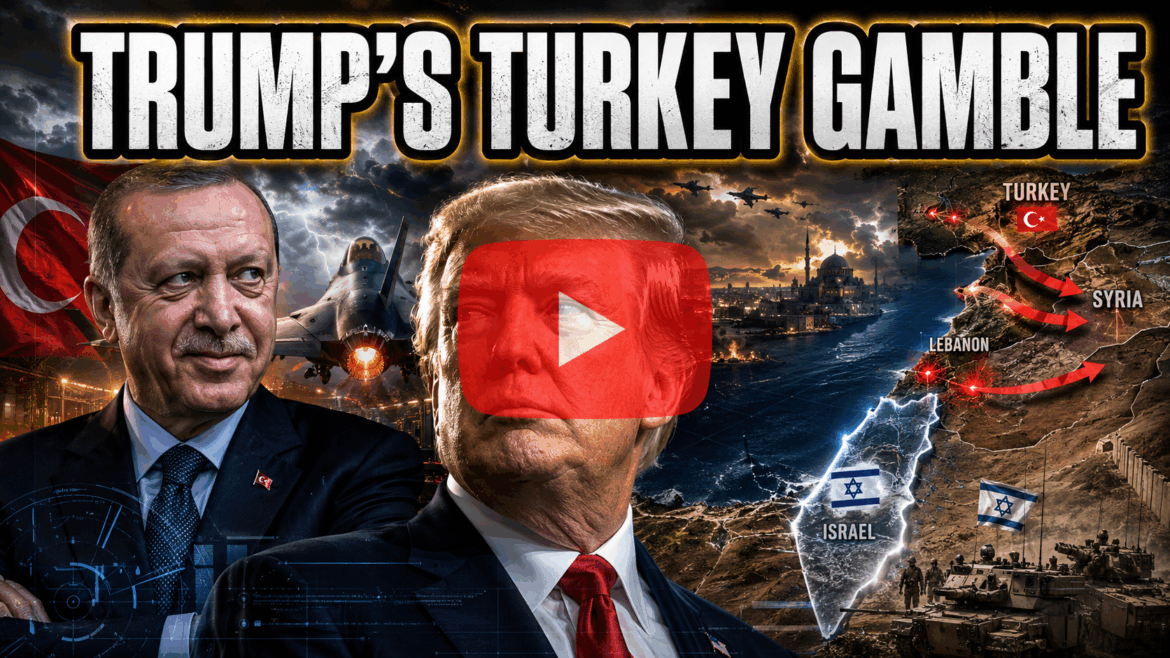
President Donald Trump’s latest comments about potentially restoring advanced military cooperation with Turkey should raise serious questions across the Middle East—especially in Israel.
When asked whether he would be bringing major defense concessions to Turkish President Recep Tayyip Erdoğan, including access to F-110 jet engines and a return to the F-35 program, Trump responded simply: “I think so. He is a NATO member.”
That answer may sound routine in Washington. In Jerusalem, it should not.
Turkey under Erdoğan is not the same ally it was decades ago. Over the past several years, Ankara has pursued an increasingly independent and Islamist-oriented foreign policy, expanded its military footprint across Syria, Iraq, Libya, and the Eastern Mediterranean, and positioned itself as a leading challenger to Israel’s regional influence.
Now connect that with another recent development.
The Trump administration has reportedly been encouraging Syria’s new leadership to confront Hezbollah inside Lebanon. On the surface, weakening Hezbollah serves Israeli interests. But the strategic question is: who fills the vacuum?
If Syria acts with Turkish backing—or increasingly under Ankara’s strategic umbrella—the result may not be a more stable Levant. It could instead accelerate Turkey’s emergence as the dominant Sunni military power stretching from northern Syria to Lebanon’s border with Israel.
That possibility deserves far more scrutiny than it is receiving.
There is an unmistakable historical parallel. The Obama administration viewed Iran as a potential pillar for a new regional balance of power, believing Tehran could help stabilize the Middle East. Critics argued that approach instead empowered Iran’s proxies across Iraq, Syria, Lebanon, and Yemen.
Is the Trump administration now making the same strategic calculation—but with Turkey?
Providing advanced fighter technology, restoring access to cutting-edge Western defense systems, and encouraging Turkish influence in Syria could ultimately strengthen Ankara’s ability to shape the future of the Levant on its own terms.
For Israel, replacing one regional hegemon with another is hardly a victory.
The goal should not simply be defeating Hezbollah. The goal should be ensuring that no hostile regional power—whether Iran or Turkey—is positioned to dominate Israel’s northern neighborhood.
History suggests that empowering ambitious regional actors often produces unintended consequences. Israel would be wise to watch this developing strategy with both open eyes.