

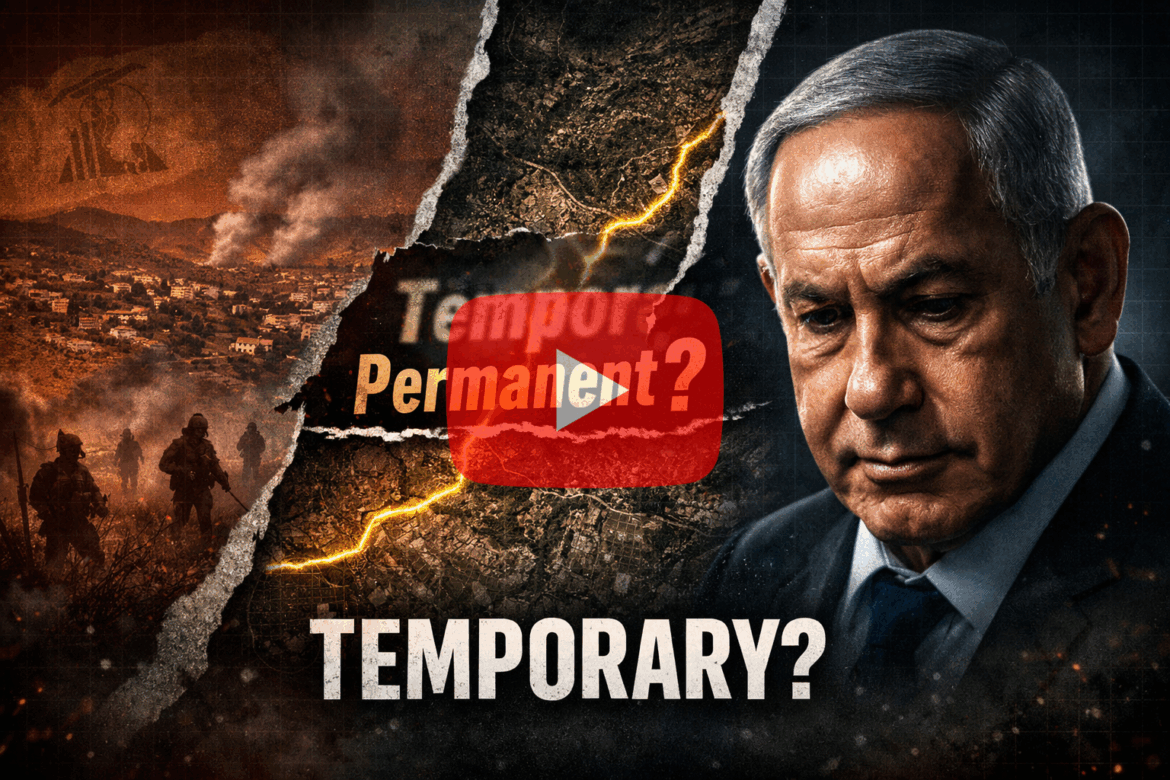
Prime Minister Benjamin Netanyahu’s latest briefing at Northern Command wasn’t just an operational update. It reflected a broader adjustment in how Israel is approaching multi-front pressure from Iran and its proxies.
The emphasis is no longer only on responding to attacks. It is on creating distance between Israeli civilians and persistent threats. In Gaza, in southern Syria, and now in Lebanon, Israel is increasingly relying on forward-positioned security zones to reduce immediate risks.
This is less about expansion, and more about changing the geometry of the battlefield.
Why a Security Zone in Lebanon Now
The logic behind expanding a security zone in southern Lebanon is straightforward.
Hezbollah’s operational model depends on proximity—anti-tank teams near the border, short-range rocket units embedded in villages, and infiltration capabilities that exploit terrain familiarity. Even limited distance can significantly degrade those capabilities.
Defense Minister Israel Katz framed the move accordingly: pushing threats further north, disrupting infrastructure, and reducing the ability to target Israeli communities directly.
From a military standpoint, this is a defensive buffer strategy, not a political redefinition of borders.
The Litani Line as a Practical Boundary
References to the Litani River are not new in Israeli strategic thinking. The river has long been viewed as a natural line that separates immediate threat zones from deeper Lebanese territory.
If Israeli forces operate consistently up to that line—controlling crossings, limiting movement, and preventing rearmament south of it—the Litani becomes a practical boundary for security purposes.
That does not make it a formal border. It does, however, create a clearer and more manageable operational environment.
Temporary by Design, Open-Ended by Reality
Israeli leadership continues to describe the zone in conditional terms: it will remain in place as long as the threat persists.
That is an important distinction. There is no formal indication of annexation, nor a declared intention to incorporate Lebanese territory into the State of Israel.
At the same time, security conditions in southern Lebanon have historically been fluid. If Hezbollah retains capabilities north of the zone, Israel may judge that maintaining a forward presence remains necessary.
In that sense, the duration of the zone is not fixed—but tied to evolving security assessments.
Lessons from the Past — Applied Differentl
Israel’s previous experience in southern Lebanon still shapes current thinking.
The earlier security zone reduced certain threats but also created prolonged friction and exposure to insurgent tactics. That experience informs today’s approach: more reliance on intelligence, more flexible force deployment, and less dependence on static positions.
The objective now appears to be maintaining deterrence and distance without replicating the vulnerabilities of the past.
Washington’s View: Alignment, with Boundaries
Donald Trump is likely to view developments in Lebanon through a broader strategic lens.
His primary focus remains Iran, regional escalation dynamics, and energy stability. Within that framework, an Israeli security buffer that reduces Hezbollah’s immediate threat may be seen as stabilizing—provided it does not expand into a wider conflict or require deeper U.S. involvement.
Support, in this context, is likely to remain pragmatic and conditional, rather than open-ended.
Implications for Lebanon and Hezbollah
For Lebanon, the expansion of a security zone adds pressure to an already fragile system. Displacement, infrastructure damage, and reduced state control in the south all contribute to long-term instability.
For Hezbollah, the impact is mixed. The group faces operational constraints in the near term, but it also retains the ability to adapt—shifting positions, recalibrating tactics, and maintaining its broader strategic posture.
The dynamic is not static. It is likely to evolve as both sides adjust.
The Likely Outcome: Sustained Buffer, Not Redrawn Borders
At this stage, the most plausible outcome is a continued Israeli security presence in parts of southern Lebanon, without formal annexation.
The zone serves a specific purpose: increasing depth, reducing exposure, and shaping the tactical environment along the northern frontier.
Whether it remains in place will depend less on political declarations and more on conditions on the ground.
For now, Israel appears focused on ensuring that its northern border is defined not just by lines on a map—but by a defensible reality.